Table of Content
This is not only to make sure ideas are exchanged clearly but also for writing reports, guidelines and recommendations, sometimes for people without an engineering background. Aside from the academic knowledge required for the role, there are a number of other skills that are important for geothermal engineers. Most geothermal engineers gain a bachelor’s degree in a subject such as engineering, biochemical engineering, chemical engineering, civil engineering, electrical engineering, or mechanical engineering. Most geothermal engineers work around 40 hours per week, with some occasional evening, weekend or holiday work. The average salary differs according to different sources but, as an example, Glassdoor.co.uk note an average salary of £37865 per year in the United Kingdom , with a range of £24-60k+ per year. The salary for geothermal engineers depends on location, duties, how many years of experience you have, and your employer.

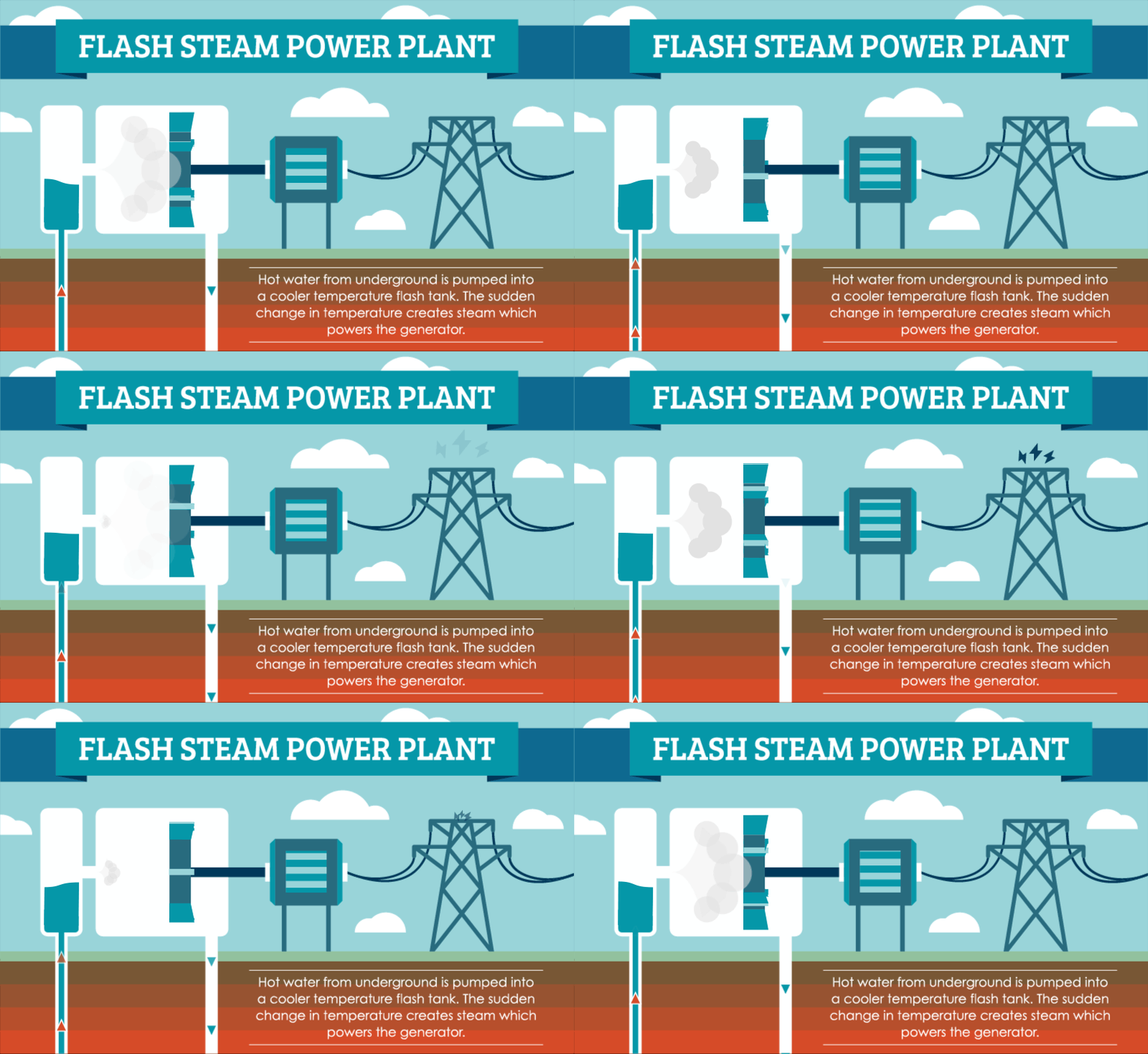
In a second approach, very hot water is depressurized or "flashed" into steam which can then be used to drive the turbine. Despite these benefits, only 47,000 geothermal units were installed last year in the U.S. That's just a tiny blip compared with the approximately one million conventional heat pumps sold during the same period, even though ground-source heat pumps cost about the same to buy. As our cave-dwelling ancestors discovered long ago, if you go far enough underground, the earth's temperature stays at a constant 50 degrees or so, no matter how hot or cold it gets outside. An air conditioner or refrigerator transfers heat in only one direction. A heat pump can transfer heat in two directions, thereby heating or cooling the space.
How Do Geothermal HVAC Systems Work?
Nevada has hundreds of hot spots, covering much of the northern part of the state. Here is an example of a typical 2,500 square foot home in Cortlandt, NY with natural gas and central air conditioning versus a Dandelion Home Geothermal Heating and Cooling System. Here is an example of a typical 2,500 square foot home in Cortlandt, NY with fuel oil heating and central air conditioning versus a Dandelion Home Geothermal Heating and Cooling System. Fuel & propane customers can save $1,000s on heating & cooling every year.

A heating and cooling load will need to be done on the home to determine the correct size of the system. A PV Solar system can provide the power needed to run a geothermal heat pump. Have your contractor do a comparative analysis between the capacity of the solar system and the required power of the heat pump system. The use of well water is an option if a body of water exist under your property and the use of a horizontal ground loop doesn’t work for lack of area or feasibility. Open loop systems require more maintenance than a closed loop, due to the minerals and other impurities that maybe in the water.
Geothermal open loop systems
Lake or pond loops are a budget-friendly option that delivers similar results. The body of water must meet specific criteria before you install a geothermal loop system. • Constantly run a small stream of water from faucets that might have pipes susceptible to freezing. "If the house is heated and you open the faucets up and you open the cabinet doors, even if you are in a really, really cold environment, it should be a pretty good fix," Brown said. Don't drop the temperature down at night in the home during frigid weather, Galeotafiore says.
You have to be careful under this agreement that you have a home inspection done to ensure there aren’t any surprises after you become the owner. In a rent-to-own contract, you’ll probably end up paying a little more than the fair market value since that money will become your down payment when your lease ends. You’re getting some benefits of renting and buying with rent-to-own homes, but with caveats that you should be aware of. • Do not use a blowtorch, kerosene or propane heater, or any other device with an open flame to attempt to thaw the pipe.
How Much Do Geothermal Heat Pumps Cost?
That same investment of $25,000 in a better thermal envelopewould likely reduce heating bills easily by 70 or 80%, perhaps more. In Iceland, virtually every building in the country is heated with hot spring water. In fact, Iceland gets more than 50 percent of its primary energy from geothermal sources . In Reykjavik, for example , hot water is piped in from 25 kilometers away, and residents use it for heating and for hot tap water. The largest geothermal system now in operation is a steam-driven plant in an area called the Geysers, north of San Francisco, California. Despite the name, there are actually no geysers there, and the heat that is used for energy is all steam, not hot water.

The study projected that such advanced geothermal systems could supply 10 percent of U.S. baseload electricity by 2050, given R&D and deployment over the next 10 years . Heat from the earth can be used as an energy source in many ways, from large and complex power stations to small and relatively simple pumping systems. This heat energy, known as geothermal energy, can be found almost anywhere—as far away as remote deep wells in Indonesia and as close as the dirt in our backyards. Some forward-thinking utilities have offered low-interest loans to homeowners willing to adopt the technology.
How Does a Geothermal System Save You Money?
This is the most common form of a geothermal heat system, as it requires less outdoor space. Holes are drilled often by a well driller and the continuous piping loops are then installed vertically. See how much money geothermal can save you on your heating and cooling bills.

The US Federal government offered a sustantial tax credit for geothermal systems, but this credit expired at the end of 2016. Hot, pressurized geothermal fluid, or a secondary working fluid, is allowed to expand rapidly and provide rotational or mechanical energy to turn the turbine blades on a shaft. Geoexchange systems can work well anywhere because they rely on the constant temperature of Earth below the frost line. DIY geothermal is becoming more popular although most homeowners search out a qualified installer. The Geothermal Exchange Organization maintains a database of geo experts by state.
Geothermal systems, such as the Dandelion Energy system, take advantage of this naturally occurring constant. They harness the steady temperature surrounding any home to heat or cool it as needed. A home would have to be quite large, and somewhat poorly-insulated to actually make it pay for itself in a reasonable time frame. Domestic Geothermal heating systems can be a great way to heat a home, replace a furnace, and are labeled as money savers. Not only do geothermal resources in the United States offer great potential, they can also provide continuous baseload electricity. With the combination of both the size of the resource base and its consistency, geothermal can play an indispensable role in a cleaner, more sustainable power system.

Underground loops can be easily installed during construction of new buildings as well, resulting in savings for the life of the building. Furthermore, recent policy developments are offering strong incentives for homeowners to install these systems. A much more conventional way to tap geothermal energy is by using geothermal heat pumps to provide heat and cooling to buildings. Also called ground-source heat pumps, they take advantage of the constant year-round temperature of about 50°F that is just a few feet below the ground’s surface.
These exciting new developments in geothermal will be supported by unprecedented levels of federal R&D funding. Under, the American Recovery and Reinvestment Act of 2009, $400 million of new funding was allocated to the DOE’s Geothermal Technologies Program. Of this $90 million went to fund seven demonstration projects to prove the feasibility of EGS technology. Another $50 million funded 17 demonstration projects for other new technologies, including co-production with oil and gas and low temperature geothermal.

Being at the mercy of an incompetent bureaucracy is not a good thing. Im currently trying to find accurate data on tue calculations of possitive vrs negative inpact on differrent sources of energy. I've been thinking about the phasing out of using fossil fuel, on and off for some time now.
It is possible to remove these excess Green Energy and Staffing costs. The areas with the highest underground temperatures are in regions with active or geologically young volcanoes. These "hot spots" occur at tectonic plate boundaries or at places where the crust is thin enough to let the heat through. The Pacific Rim, often called the Ring of Fire for its many volcanoes, has many hot spots, including some in Alaska, California, and Oregon.



No comments:
Post a Comment